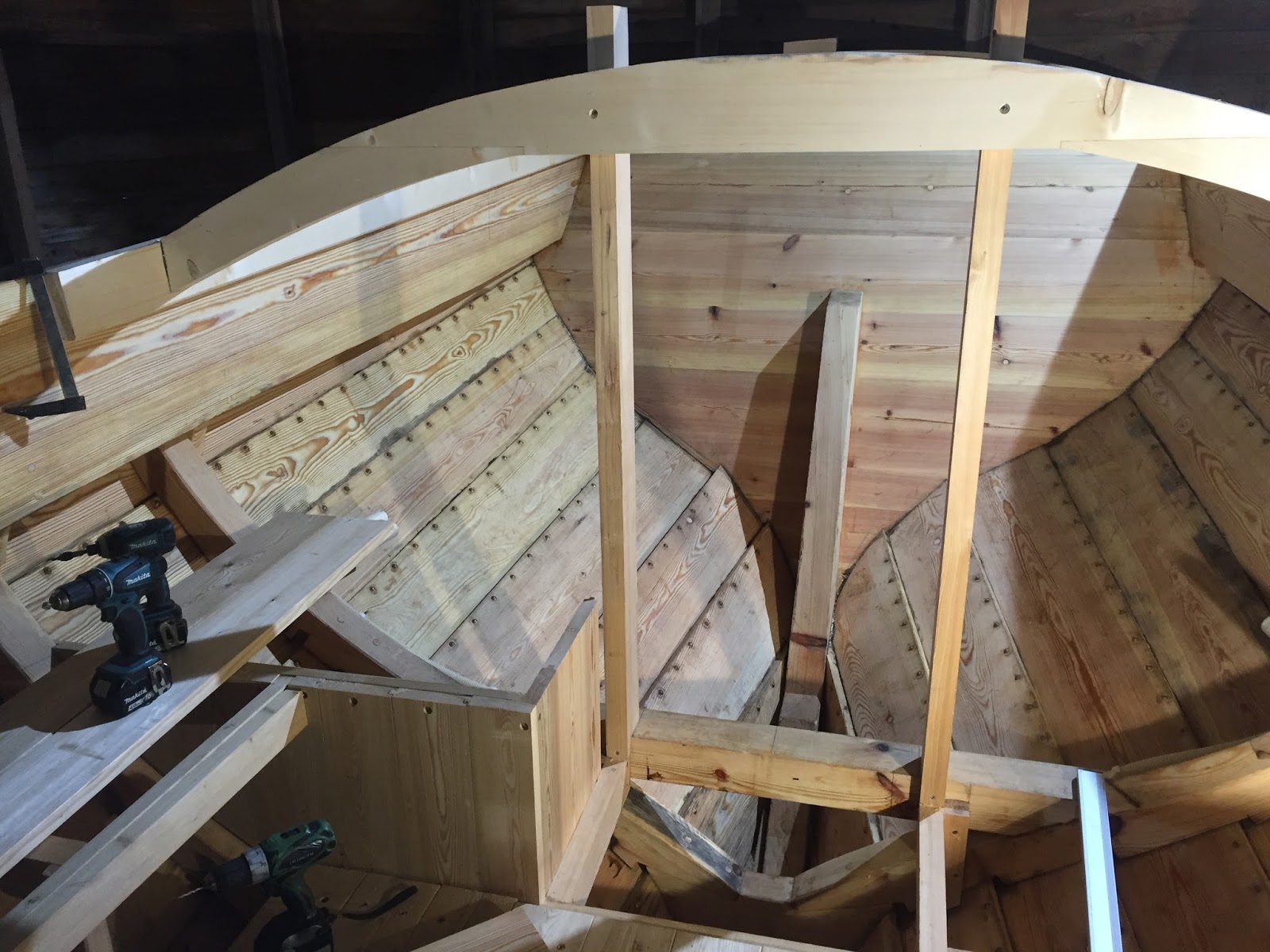
Muutaman kuukauden aherruksen jälkeen olemme saaneet avotilan melkein valmiiksi ja kattopalkkejakin on jo paikalla.
Peräsinpinna on tehty tammesta ja kuten tässä projektissa on tapana niin siitäkin tuli iso...
--------------------------------------------------------------------------------------------------------------------------
After a couple months of labor we have now almost done with the cockpit. Beams for the cabin tops are made and almost all installed.
The bulkheads are taking shape and we made had the tiller arm made. The tiller arm is made out of oak and it is long and large as it should be on a "bigboat"
Avotilan rakenne oli aikamoista lovetus- / puusepäntyötä, mutta hieno siitä tuli...
The support beams and the structure for the cockpit was a real exercise of joinery skills but it turned out very nice and solid.
Tässä näkyy tankkien ja moottorin sijainnit. Isompi tankki on vesi- ja pienempi on septitankki. Moottori mahtuu mainiosti lattian alle.
This shows the location of the tanks. The larger one is the fresh water tank and the smaller one is the septic tank. The motor fits well and clear under the cockpit sole.
Näkymä hytistä taaksepäin. Oviaukko ja kattoprofiili on paikallaan.
Here is a view from inside the cabin facing aft. The doorway is in place and the temp.beam for the cabintop shows the roofline.
Lattialuukut tehtiin siten että tankit on helppo tarkistaa ja moottoriin pääsee hyvin käsiksi. Koko lattian voi nostaa helposti osissa pois.
The cokcpit sole is made out several hatches all of which can be taken out for future service. The tanks and motor remain easily accessible.
Ankkurilaatikon seinä tehtiin ja keulan avotila alkaa muodostua...Mittasimme penkkien ja rakenteiden paikat laserilla.
The bulkhead for the lazarette for the anchor and its chain was built and the cockpit up in the bow of the boat was measuread and marked on the frames.
Hytin seinä alkaa muodostua. Materiaallina on siperian lehtikuusesta tehtyä ponttipanelia.
The bulkhead for the main cabin is taking shape. It is made out of Larix with a tonque and groove joint.
Avotilan penkin säilytyslaatikko.
The lazarette / fender storage under the seat.
Oviaukko takahyttiin on valmis. Näihin säiltyslaatikoihin tulee moottorin ohjausyksikkö ja webaston tankki.
The doorway in to the aft cabin / head is ready. The lockers will house the main controller unit for the motor and the diesel tank for the Webasto heater unit.
Peräsinpinna paikallaan ja näyttää jo aika hyvältä...
With the tiller arm in place you can almost feel the ocean...
Webaston ilmaputki
The air duct for the Webasto heater.
Yli puolet kattokaarista on paikallaan...Hytin koko alkaa hahmottumaan. Sähköputketkin on vedetty jo paikalleen.
With more than half of the cabintob beams in place one is getting the feel for the space inside the main cabin. The cable trays / tubes are in place.
Vielä hiukan hommaa, niin hytti on valmis...
Just a little work and the cabin is ready :)
Storbåtin perinteisiä rikityyppejä ovat :
- Raakapurje
- Spriipurje
- Kahvelipurje
Fokkaa käytettiin yleisesti Spriipurjeen ja Kahvelipurjeen kanssa. Toppiseili oli käytössä suurimmissa isoveneissä. Joissakin veneissä oli vielä irroitettavan keulapuomin päässä klyyvaripurje.
Maston paikka riippui rikityypistä ja purjeiden painopisteistä. Tämä vaikuttaa suoraan myös peräsimeen kohdistuvaan paineeseen ja veneen ohjattavuuteen.
Me päädyimme kahvelirikiin ja toppiseiliin.
-----------------------------------------------------------------------------------------
The traditional rig types that were used on these boats were:
- Squaresail
- Spritsail
- Gaffsail
Staysails were used with the Sprit and Gaff mainsails and the larger boats were often rigged with a topsail. Some boats even had a removable bowsprit for a jib.
The location of the mast was determined by the selected rig type. The rudder balance had to be considered especially with the large mainsails.
We ended up selecting a gaff-rig with a staysail and a topsail.
Seuraavaksi tutkimme veneen ohjailtavuutta. Sitä varten laskimme kaikkien purjeiden painopisteet. Purjeiden yhteistä painopistettä verrataan rungon vedenalaisen osan eli uppoaman painopisteeseen ja näistä syntyy veneen ohjailtavuus.
Kahvelirikissä suositellaan purjeiden painopistettä 6-20% edempänä kuin uppoaman painopistettä. Leveän ja matalasyväyksisen veneen kanssa voidaan käyttää tämän säännön alkupäätä eli n.6% eroa.
Ensimmäiset laskelmat osoittivat eroa olevan ainoastaan 2% joka aiheuttaisi purjehdustilanteessa kovan peräsinpaineen ja tekisi veneestä tosi raskaan ohjattavan. Tämän takia päätimme siirtää mastoa n.30 cm eteenpäin ja uudet laskelmat osoittivat n.8-9% eroa joka on huomattavasti parempi jolloin vene on varmaankin suht' kevyt ohjattava ja ennenkaikkea perämiehen hallittavissa.
-----------------------------------------------------------------------------------------------------------------------------
Once we had decided on the rigtype we started focusing on the sail-balance. In order to figure out how easy it would be to steer the boat the center of effort of the all sails combined must be compared against the center of floatation. The center of effort of the sails should be about 6-20% further towards the bow than the center of floatation. This difference is called "Lead". On a wide and shallow draft hull you can be closer to 6% than 20% lead.
Our initial calculations showed only 2% lead so we decided to move the mast forward by about 30cm. This improved the balance as the lead was now about 8-9%. This will have a direct impact on how easy it is to steer the boat and how much of a weather helm it has. This number is a very good one and so we proceeded to order the sails based on this.
Purjepinta-ala jakautuu seuraavasti :
- Isopurje : 39 neliötä
- Fokka : 13 neliötä
- Toppiseili : 8 neliötä
-----------------------------
Yht. 60 neliötä
Väriksi valikoitui, hieman vahingossa, ruosteenpunainen...ja purjeet tilattiin Englannista (Jeckell's). Kyseinen purjeneulomo on tehnyt työveneiden purjeita 1800-luvun alusta asti joten kokemusta on.
-------------------------------------------------------------------------------------------------------------------------------
The sail area is divided as follows :
- Mainsail : 39 square meters
- Staysail : 13 square meters
- Topsail : 8 square meters
-------------------------------------
Total sail area : 60 square meters
The color was chosen (by mistake) as Tanbark. The sails were ordered in England, Jeckell's sail loft. Jeckell's has been making sails for workboats since the early 1800s so they have a lot of experience.
 Purjeet "koelevitettiin" Turun Weneveistämön lattialle ja hyvältä näyttää. Mitat vastaa piirustuksia. Kesällä 2016 nähdään toimiiko purjeet käytännössä samalla tavoin kuin paperilla teoriassa.
---------------------------------------------------------------------------------------------------------------------------------
We laid out the sails on the floor of the old boat yard to see how they look and most of all the measurements matched with the drawings. It will be interesting to see if the performance is similar in real life as on the paper...We will find it out in the summer of 2016 !!
Purjeet "koelevitettiin" Turun Weneveistämön lattialle ja hyvältä näyttää. Mitat vastaa piirustuksia. Kesällä 2016 nähdään toimiiko purjeet käytännössä samalla tavoin kuin paperilla teoriassa.
---------------------------------------------------------------------------------------------------------------------------------
We laid out the sails on the floor of the old boat yard to see how they look and most of all the measurements matched with the drawings. It will be interesting to see if the performance is similar in real life as on the paper...We will find it out in the summer of 2016 !!
Talven paukkupakkasilla veneen rakentaminen on ollut hidasta...aika on käytetty lähinnä tarvittavan puumateriaalin keräämiseen. Avotilan tukirakenteet ja turkkitaso tehdään Siperian Lehtikuusesta. Se soveltuu erinomaisesti ulkotiloihin. Haittana on lähinnä suuri ominaispaino...
Avotilan korotetun turkkitason alle tulee moottori, septi, ja vesitankki. Sekä pieni tankki Webastolle.
----------------------------------------------------------------------------------------------------------------------------------
The first couple weeks in January were extremely cold and we could not really build anything so the time was best spent in organising all the lumber needed for the build. The material we are using in all outdoor areas is called Larix. The lumber is from the vast forest of Siberia, slowly grown and excellent in durability and ability to withstand water and marine conditions. The only drawback is that it is very heavy material.
The 1st thing will be the cockpit which has a raised floor. Under the floor is the machinery space with the motor, water-, and wastewater tanks. We will end up having a little diesel tank onboard for the Webasto blower / heater unit.
Poikittaiset tukipalkit on liimattu kahdesta 50 x 100mm palkista. Päät lovetaan kaarien muodon mukaan. Taltta tulee tutuksi...
--------------------------------------------
The support beams are made by gluing 2 beams (50 x 100)mm together. The ends will have to be slotted to fit the frame. It is a great excersice of how to work with the chisel.
Moottori kiinnitettiin asennuspetiinsä ja nostettiin alustavasti paikalleen. Lopullinen linjaus tehdään myöhemmässä vaiheessa.
-------------------------------------------------------
The motor was attached on its' mounting bracket and the whole thing was lifted inside the boat to its' rough location. The final alignment will be done a bit later.
Moottori näyttää suht' pieneltä näin ison veneen pohjalla...
The motor appears very small in such a large boat...
Tukipalkit menevät paikalleen ja lattiapinta muodostuu.
The support beams are fitted in and one can visualize the floorspace.
Tässä kuvassa näkyy tasaisen lattian rajat (reunalaudat). Laserilla merkitään seuraava korkeus eli penkkien pinta. Seuraavaksi laitamme viimeiset pitkittäis- ja poikittaistuet lattiapintaan jonka jälkeen alkaa penkkien rakentaminen.
This picture shows the size of the even floor (between the two planks). We are using the laser to mark the height of the bench seats that will be on both sides of the cockpit. Next up we will put in place the longitudinal beams and the remaing transverse support and legs for the bench seats.
Veneen kyllästys sujui hienosti ja n.200 litraa pellavaöljyä imeytyi runkoon ja kaariin. Prosessi kesti n.kolme viikkoa, mutta jälki on hienoa ja runko on nyt myös hieman tummempi ja pinta satiinimainen.
------------------------------------------------------------------------------------------------------------------------------
The hull was oiled in a period of three weeks of constant attention. The fibre of the timber soaked up about 200 litres of linseed oil. The end result is a slightly darker hull with a non-gloss, satin-type finish.
Käsittelyn jälkeen oli aika kutsua paikalle Varsinais-Suomen Venekuljetus ja siirtää vene takaisin sisätiloihin jossa sisustus- ja asennustyöt tehdään valmiiksi.
-------------------------------------------------------------------------------------------------------
After the boat dried-up we prepared it for yet another move...This time it will be the last move before the launch. During the next 6 months the boat will be indoors for outfitting and completion of the interior.
Veneen kauniit muodot näkivät taas päivänvalon !!
As the boat came out of the shed it was time to admire the beautiful shape and finish of the hull !!
Peräpeili on ylvään näköinen ja muistuttaa hieman vanhoja purjelaivoja !!!
The transom has a very nice shape that sort of resembles the old, larger sailing ships !!!
Vene on nyt turvallisesti uudessa kodissa ja verstas veneen vieressä on valmis tulevia töitä varten.
Everything went well and the boat is now inside its' new home. We have finished building the workshop next to the boat and we are now ready to start the work of outfitting.